2009 年
生物 · 共 60 題 · 點擊選項即時核對答案
Questions 40 and 41 refer to the set-up shown below for investigating the respiration of woodlice. The liquid levels on both sides of the U-tube (X and Y) were the same at the beginning of the experiment.
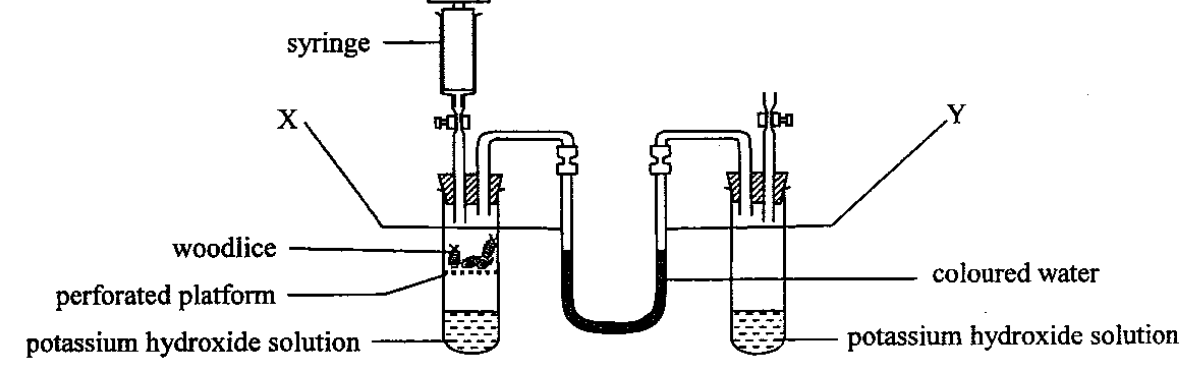
At the end of the experiment, a sample of gas was withdrawn from the tube using the syringe. The sample was tested for the presence of carbon dioxide. Which of the following combinations correctly lists the chemical used for the test and the result?
| Chemical used for the test | Result | |
|---|---|---|
| lime water | remained colourless | |
| lime water | turned milky | |
| hydrogencarbonate indicator | changed from purple to red | |
| hydrogencarbonate indicator | changed from red to yellow |
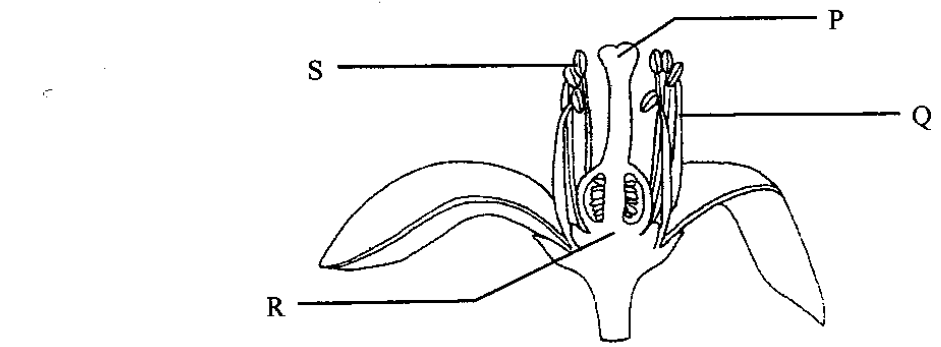
The photomicrograph below shows the appearance of a pollen found in a certain part of a flower:

In which labelled part of the flower below is this pollen found?
The following diagram shows a vertical section of a tomato:
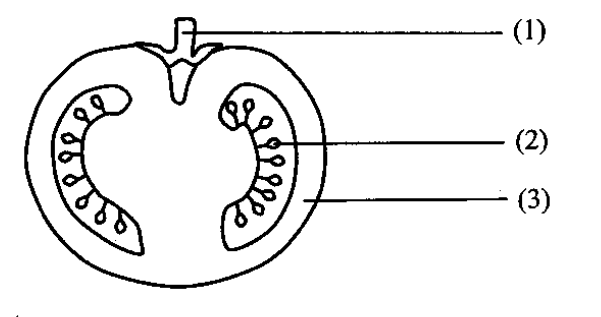
Which of the following correctly identifies the floral parts from which structures (1), (2) and (3) have developed?
| (1) | (2) | (3) | |
|---|---|---|---|
| style | ovary | ovule | |
| style | ovule | ovary | |
| flower stalk | ovule | ovary | |
| flower stalk | ovary | ovule |
The tip of the stem of a flowering plant was removed. This tip was cut into small pieces and one piece was placed in an agar containing nutrients and plant hormones to encourage growth. The photograph below shows the green plantlet formed after 4 weeks.
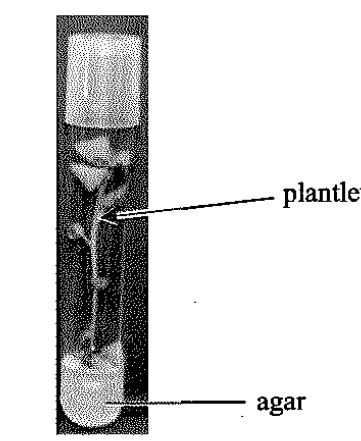
Which of the following combinations correctly identifies this type of reproduction and the characteristic of the plantlet produced?
| Type of reproduction | Characteristic of the plantlet | |
|---|---|---|
| sexual reproduction | its genotype is different from its parent | |
| sexual reproduction | it can produce flowers when fully grown | |
| asexual reproduction | its genotype is identical to its parent | |
| asexual reproduction | it cannot produce flowers when fully grown |
The photographs below show four different plant structures:
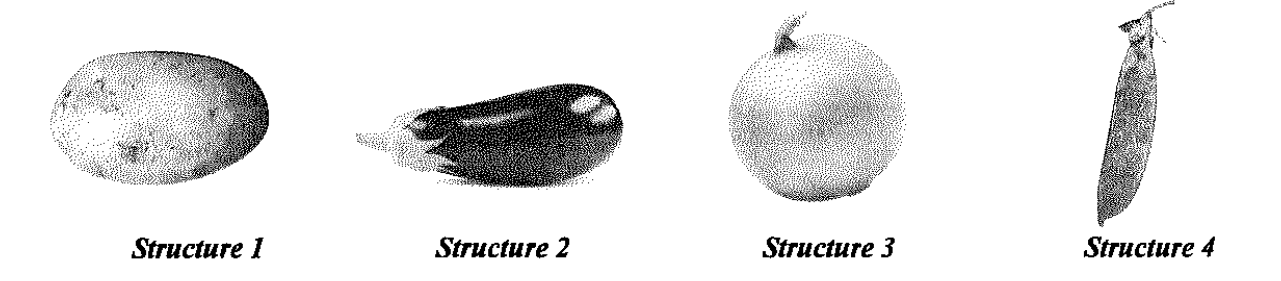
Which of the above structures are formed from sexual reproduction?
A student carried out an experiment to find out how the storing conditions affect the germination of a type of seeds. The storing conditions and the percentage of seeds germinated after storage are summarized in the following table.
| Temperature (°C) | Relative humidity (%) | Period of storage (day) | Percentage of seeds germinated after storage |
|---|---|---|---|
| 5 | 20 | 10 | 24 |
| 5 | 85 | 10 | 20 |
| 25 | 20 | 100 | 90 |
| 25 | 85 | 10 | 92 |
Which of the following can be concluded from the above results?
The diagram below shows the human male reproductive system:
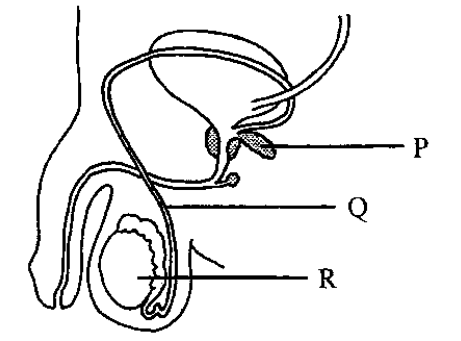
In which of the labelled parts does mitotic cell division occur?
Figure I shows a contraceptive device. Figure II shows the human female reproductive system.
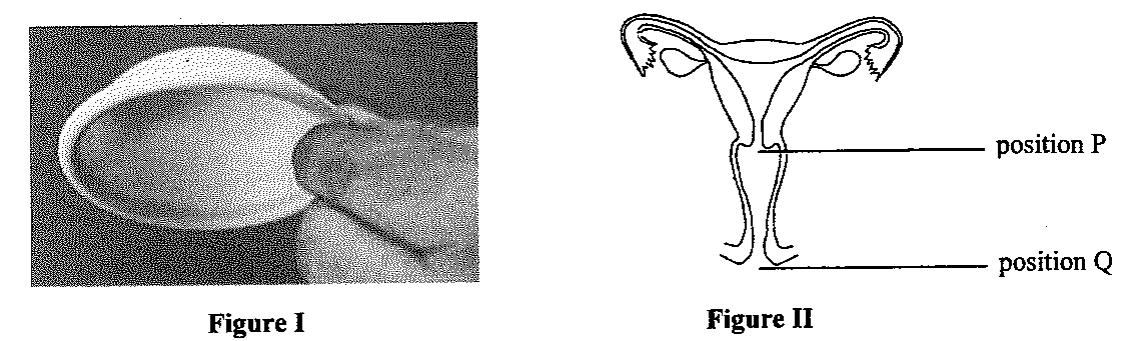
Which of the following combinations correctly states the function of the contraceptive device and the position where this device should be placed?
| Function | Position | |
|---|---|---|
| to stop the sperms from entering the uterus | P | |
| to stop the sperms from entering the vagina | P | |
| to stop the sperms from entering the uterus | Q | |
| to stop the sperms from entering the vagina | Q |
The table below shows some characteristics of three newborn triplets:
| Characteristic | Baby (1) | Baby (2) | Baby (3) |
|---|---|---|---|
| Sex | male | male | male |
| Weight (kg) | 2.0 | 2.0 | 1.6 |
| Body length (cm) | 40 | 38 | 34 |
| Colour of eyes | blue | brown | brown |
Which of the following conclusions can be drawn from the above information?
The following photomicrographs show some stages in a cell division:
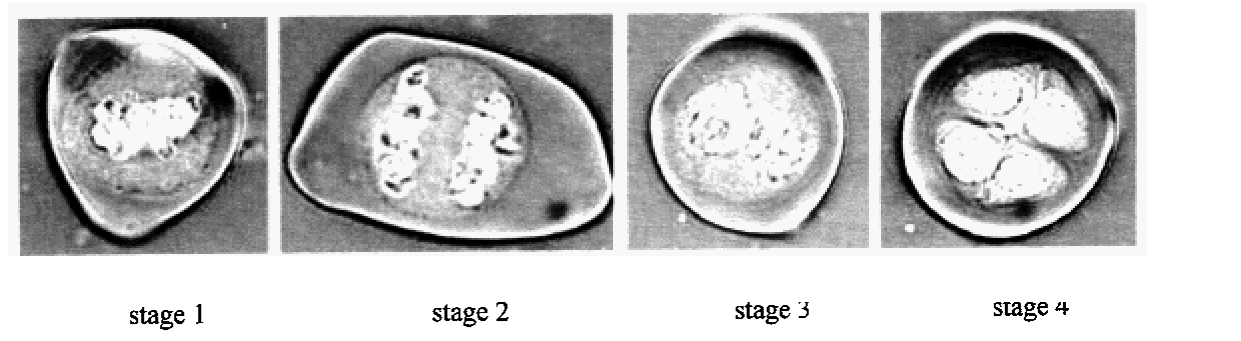
Which of the following combinations correctly states the type of cell division and the event taking place at the particular stage?
| Type of cell division | Event | |
|---|---|---|
| mitotic cell division | replication of chromosomes in stage 1 | |
| mitotic cell division | separation of homologous chromosomes in stage 2 | |
| meiotic cell division | replication of chromosomes in stage 3 | |
| meiotic cell division | formation of daughter cells in stage 4 |