1998 年
化學 · 共 49 題 · 點擊選項即時核對答案
Consider the following experiment.
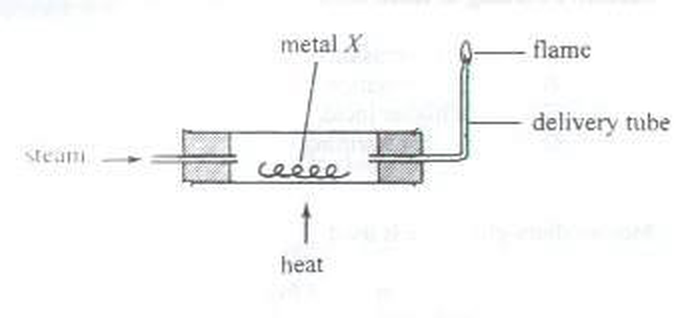
During the experiment, a gas is liberated. The gas burns at the end of the delivery tube. X is probably
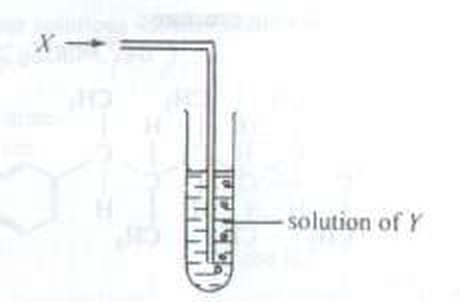
A gas X is bubbled into a solution of Y as shown in the above diagram. In which of the following combinations would X react with Y ?
| X | Y | |
|---|---|---|
| Ammonia | Potassium nitrate | |
| Chlorine | Potassium nitrate | |
| Carbon dioxide | Sodium hydroxide | |
| Sulphur dioxide | Iron(II) sulphate |
In an experiment, 10 cm³ of 1 M hydrochloric acid is added slowly into 10 cm³ of 1 M sodium hydroxide solution. Which of the following statements concerning this experiment is correct ?
Which of the following statements concerning propene is correct ?
A detergent has the following structure:
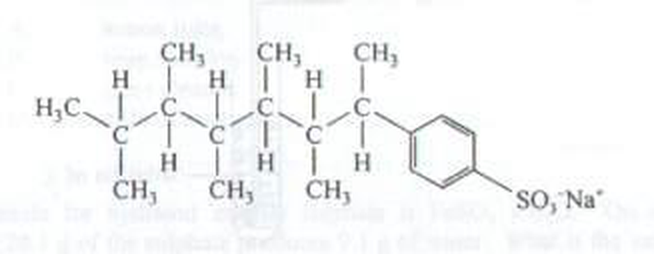
Which of the following statements concerning the detergent is correct ?
The formula of a solid dibasic acid is H₂X. 2.88 g of the acid is dissolved in some distilled water and the solution is then diluted to 250.0 cm³ with distilled water. 25.0 cm³ of the diluted solution requires 16.0 cm³ of 0.40 M sodium hydroxide solution for complete neutralization. What is the molar mass of H₂X ?
Which of the following statements concerning the compounds C₂H₄, C₃H₆ and C₄H₁₀ is correct ?
Which of the following ions has the same number of protons as the hydroxide ion, OH⁻ ?
In each of the four solutions shown below, a strip of zinc is added.
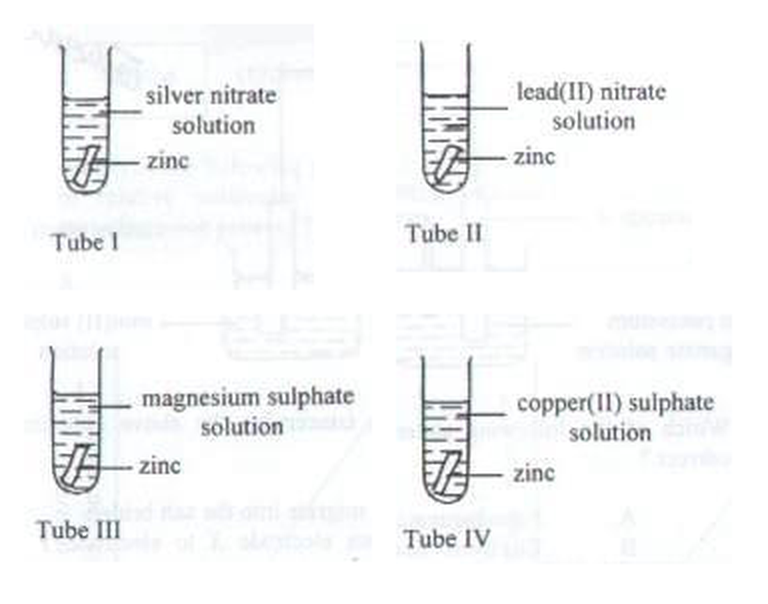
Which of the following combinations is correct ?
| Tube | Observation | |
|---|---|---|
| I | No change | |
| II | Brown coating on zinc | |
| III | No change | |
| IV | Grey coating on zinc |
The following equation represents the reaction of an oxide of lead with hydrogen : Pb₃O₄(s) + 4H₂(g) → 3Pb(s) + 4H₂O(l) What mass of lead would be obtained if 68.5 g of the oxide was consumed in the reaction ? (Relative atomic masses : O = 16.0, Pb = 207.0)