2007 年
化學 · 共 49 題 · 點擊選項即時核對答案
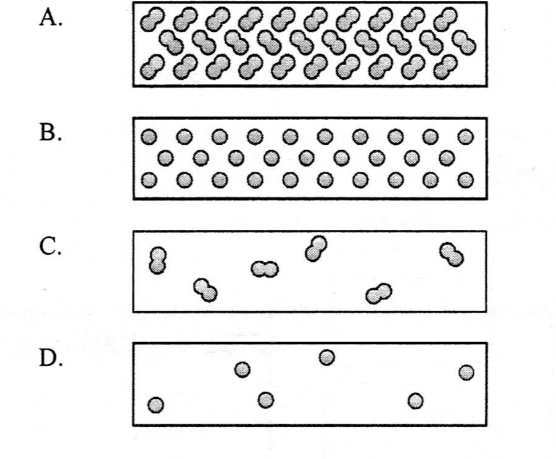
Questions 31 and 32 refer to the element astatine (At), which has an atomic number of 85.
Which of the following diagrams best represents the arrangement of particles in a sample of astatine at room temperature and pressure ?
Questions 31 and 32 refer to the element astatine (At), which has an atomic number of 85.
Which of the following statements concerning astatine is correct ?
50 cm³ of carbon monoxide burns completely in 50 cm³ of oxygen. Assuming that all volumes are measured at room temperature and pressure, what is the final gaseous volume at the end of the combustion ? (Molar volume of gas at room temperature and pressure = 24 dm³)
What mass of iron can be obtained by complete reduction of 7.18 g of iron(III) oxide ? (Relative atomic masses : Fe = 55.8, O = 16.0)
Different metals are dropped into water or dilute hydrochloric acid. Assuming that the experimental conditions are the same, which of the following comparisons concerning the initial rates of hydrogen formation is correct ?
| Initial rate of hydrogen formation | Initial rate of hydrogen formation | ||
|---|---|---|---|
| Ca and H₂O | > | Ba and HCl | |
| Fe and HCl | > | K and H₂O | |
| K and H₂O | > | Cs and H₂O | |
| Cs and H₂O | > | Ca and H₂O |
The following diagram represents a chemical cell called fuel cell.
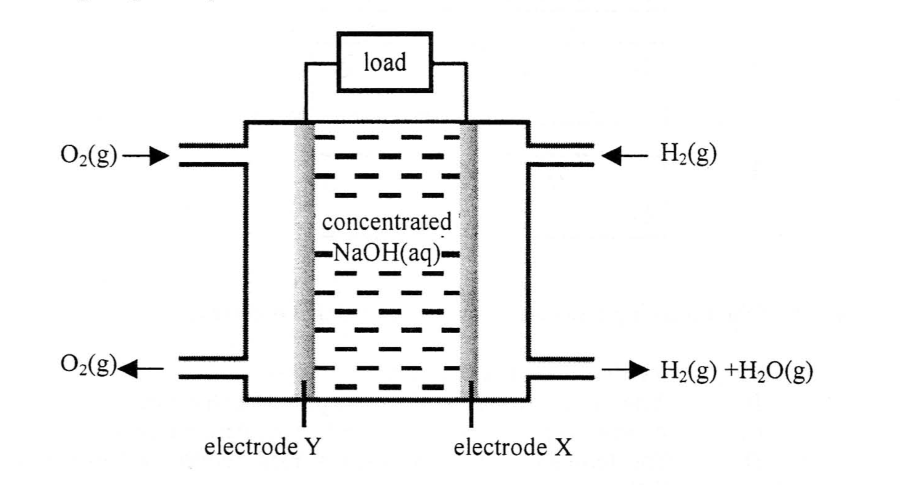
Hydrogen and oxygen are passed into the fuel cell. The half equations for the chemical changes occurring at electrode X and electrode Y are listed below : at X : H₂ + 2OH⁻ → 2H₂O + 2e⁻ at Y : O₂ + 2H₂O + 4e⁻ → 4OH⁻ Which of the following statements concerning the fuel cell is correct ?
Which of the following mixtures can produce chlorine ?
Which of the following methods is most suitable for preparing a sample of lead(II) sulphate ?
CO₂(g), SO₃(g) and O₂(g) are composed of atoms of different elements. At room temperature and pressure, what is the ratio of the number of atoms involved in 100 cm³ of CO₂(g), 100 cm³ of SO₃(g) and 200 cm³ of O₂(g) ? (Molar volume of gas at room temperature and pressure = 24 dm³)
When 10 g of PURE calcium carbonate (molar mass = 100.1 g) reacted with excess hydrochloric acid, 2.40 dm³ of carbon dioxide was obtained at room temperature and pressure. However, in a similar experiment using 10 g of IMPURE calcium carbonate, 2.50 dm³ of carbon dioxide was obtained. Assuming that the impurity is a metallic carbonate, what would this impurity be ? (Molar masses : MgCO₃ = 84.3 g, ZnCO₃ = 125.4 g, FeCO₃ = 115.8 g, CuCO₃ = 123.5 g ; molar volume of gas at room temperature and pressure = 24 dm³)