功、能和功率
物理 · 共 70 題 · 點擊選項即時核對答案
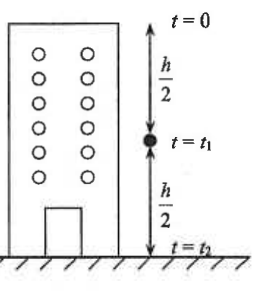
An object is released from rest at the top of a building of height . At time , the object is at the half of the height of the building as shown in the figure. At time , the object just reaches the ground. Which of the following is/are correct ? (Neglect air resistance.)
A fish jumps up vertically to a maximum height of m above the water surface. What is the speed when it just leaves the surface ?
A car is travelling at a constant speed of along a horizontal straight road. The total resisting force acting on the car is N. Which of the following statements are correct ?
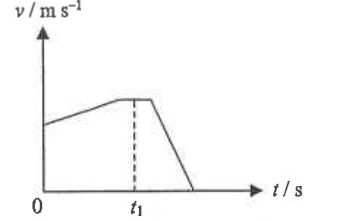
The figure above shows the velocity - time graph of a car travelling on a horizontal straight road. Which of the following statements is/are correct ?
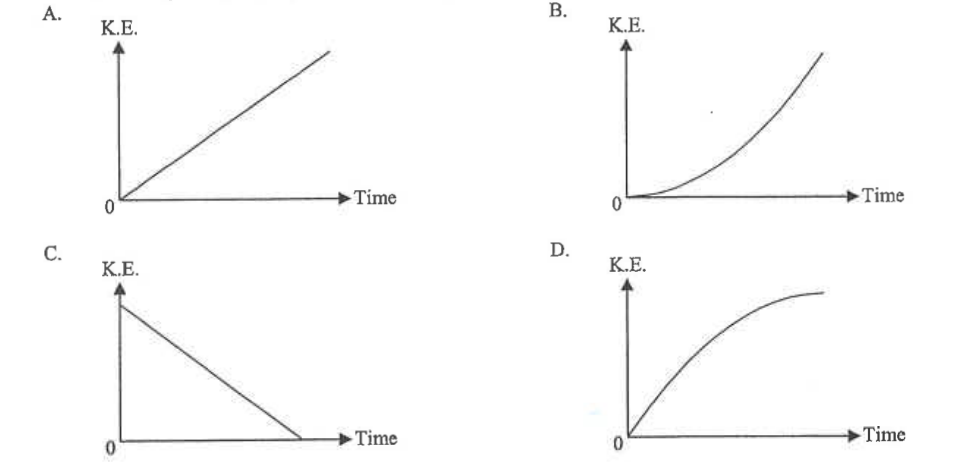
An object is released from rest. Which of the following graphs best describes the variation of the kinetic energy of the object with time during falling ? (Neglect air resistance.)
When a skydiver falls steadily in air under no net force, which of the following descriptions about his gravitational potential energy, kinetic energy and power in overcoming air resistance is correct ?
| Gravitational potential energy | Kinetic energy | Power in overcoming air resistance | |
|---|---|---|---|
| decreases | increases | increases | |
| decreases | increases | remains unchanged | |
| decreases | remains unchanged | remains unchanged | |
| remains unchanged | increases | increases |
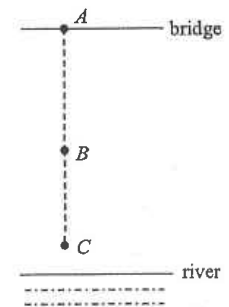
John performs a bungee jump from a bridge above a river. He (assumed to be a particle) is tied to the bridge at with an elastic cord. He falls from rest at . When he reaches , the elastic cord starts to stretch. John is momentarily at rest at and then bounces up. Which of the following descriptions about the motion of John is/are correct ? (Neglect the air resistance.)
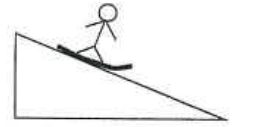
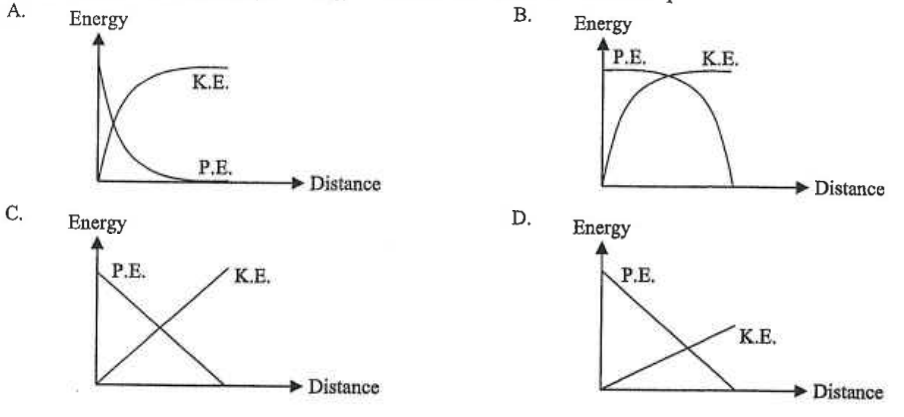
A skier slides down a slope as shown in the diagram above. Assume constant friction along the slope, which of the following graphs best describes the change of energy of the skier with distance down the slope ?
An electrical toy car of mass goes up an inclined plane of inclination with constant speed . The air resistance acting on the car is half of the weight of the car. What is the average power of the car ?
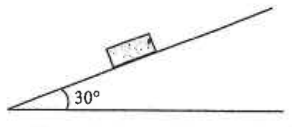
A block of mass kg is sliding down with constant speed along an inclined plane of inclination to the horizontal. What are the gain in kinetic energy and the work done against friction by the block after travelling a distance of m along the plane ? (Take the acceleration due to gravity to be .)
| Gain in kinetic energy / J | Work done against friction / J | |
|---|---|---|
| 0 | 10 | |
| 10 | 10 | |
| 0 | 20 | |
| 10 | 30 |