物態變化
物理 · 共 52 題 · 點擊選項即時核對答案
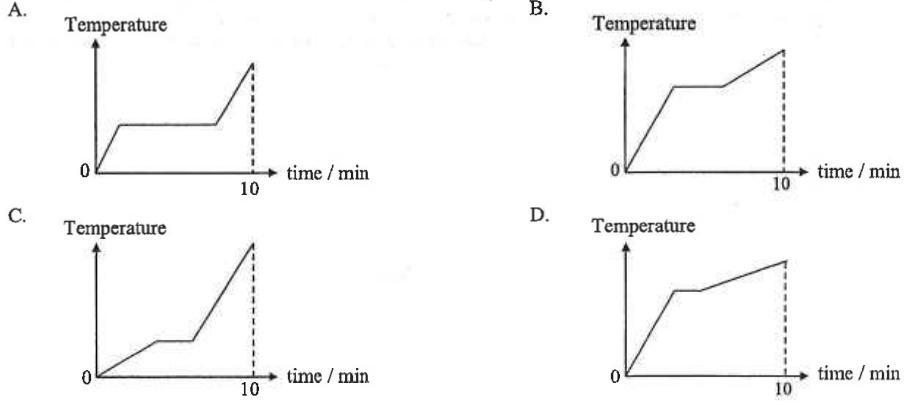
Five different solids, each of mass kg, are heated by identical immersion heaters for minutes. The following graphs show their heating curves. Assuming no loss in heat, which solid has the greatest specific latent heat of fusion ?
Arrange the following in ascending order. Energy required to melt kg of ice at Energy required to raise the temperature of kg of copper by Energy required to vaporize kg of water at Energy required to raise the temperature of kg of water by
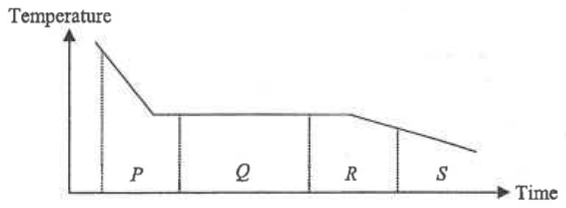
The graph shows the cooling curve of liquid naphthalene. In which region has naphthalene completely solidified ?
Heat is needed to keep water boiling because energy is required to
If an immersion heater takes minutes to bring a cup of water to its boiling point from the room temperature of , what will be the time taken for the boiling water to vaporize completely ? (Specific heat capacity of water ; specific latent heat of steam .)
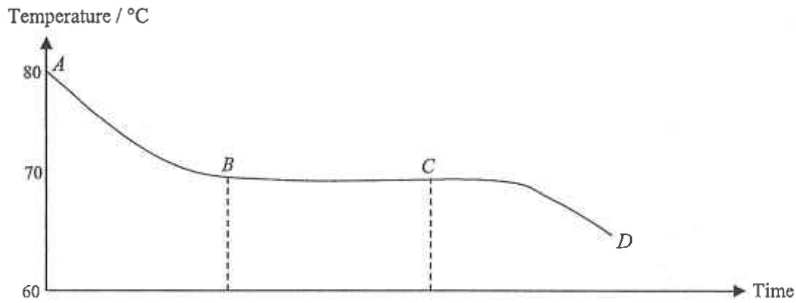
A cooling curve for liquid naphthalene is shown above. From the graph, which of the following statement(s) is/are true ?
It is given that : the specific latent heat of fusion of ice the specific latent heat of vaporization of water If kg of ice at and kg of steam at are mixed in a well insulated vessel, the result will be
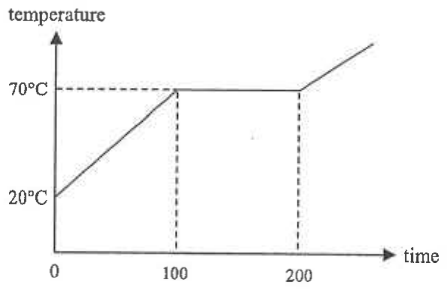
A solid substance of mass kg and specific heat capacity is heated uniformly by a constant heat source. The temperature-time graph of the substance is shown in the graph. Assuming that no heat is lost, find from the graph the specific latent heat of fusion of the substance.
The following data shows the thermal properties of four substances , , and :
| Substance | ||||
|---|---|---|---|---|
| Melting point | K | K | K | K |
| Boiling point | K | K | K | K |
| Average specific heat capacity in | ||||
| Specific latent heat of fusion in | ||||
| Specific latent heat of vaporization in |
When the temperature of each substance is increased from K to K, which one will absorb the greatest amount of energy ?
A liquid placed inside an insulated vessel is kept boiling by a heating coil immersed in it. When the power supplied to the coil is W, the liquid boils away at a rate of kg s. What is the specific latent heat of vaporization of the liquid ?