1991 年
化學 · 共 36 題 · 點擊選項即時核對答案
Directions: Questions 1 and 2 refer to the following table.
| Element | W | X | Y | Z |
|---|---|---|---|---|
| Atomic number | 4 | 8 | 14 | 20 |
Which of the following elements are likely to be metals ?
Directions: Questions 1 and 2 refer to the following table.
| Element | W | X | Y | Z |
|---|---|---|---|---|
| Atomic number | 4 | 8 | 14 | 20 |
The formula of the compound formed between X and Z is likely to be
Solid X undergoes complete thermal dissociation according to the following equation: X(s) → Y(g) + Z(s) On heating 4.90 g of solid X, 1.40 dm³ of gas Y and 2.30 g of solid Z are obtained at room temperature and pressure. What is the relative molecular mass of Y? (Molar volume of gas at room temperature and pressure = 24 dm³)
Tetrachloromethane is a common solvent in the chemistry laboratory. Which of the following hazard warning labels should be displayed on a bottle of tetrachloromethane?

Direction: Questions 6 and 7 refer to the following electrolysis experiment.
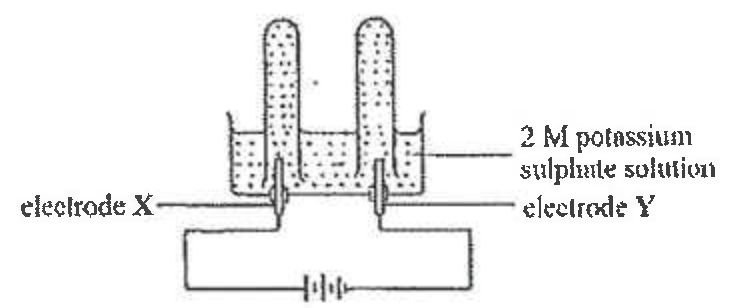
The gases collected at electrodes X and Y respectively are in the volume ratio of
Direction: Questions 6 and 7 refer to the following electrolysis experiment.
Which of the following statements concerning the experiment is/are correct ?
X, Y and Z are metals. Y can displace X from a solution of the nitrate of X. Oxides of X and Y can be reduced by hydrogen but not the oxide of Z. Which of the following arrangements represents the correct descending order of reactivity of the metals ?
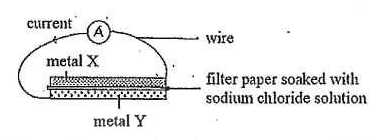
Which of the following combinations would produce the largest current flowing from metal X to metal Y in the external circuit ?
| Metal X | Metal Y | |
|---|---|---|
| Fe | Cu | |
| Mg | Ag | |
| Ag | Zn | |
| Cu | Pb |
Dry chlorine is passed in excess over heated copper powder and iron powder as shown in the diagram below:
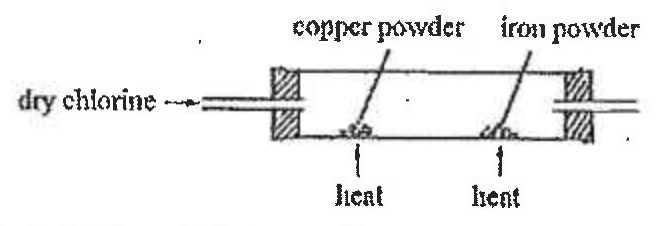
What is/are the product(s) at the end of the experiment ?
2.60 g of a metal X combine with 1.20 g of oxygen to form an oxide in which the oxidation number of X is +3. What is the relative atomic mass of X ? (Relative atomic mass: O = 16.0)