1994 年
化學 · 共 32 題 · 點擊選項即時核對答案
If the atomic number of an element X is 13, the formula of its oxide is
Consider the information given in the table below:
| Atom | Atomic number | Mass number | No. of neutrons |
|---|---|---|---|
| P | 6 | 14 | |
| Q | 7 | 14 | |
| R | 13 | 7 | |
| S | 18 | 10 | |
| T | 10 | 10 |
Which of the following atoms are isotopes ?
Which of the following molecules has the greatest number of lone pairs of electrons ?
Both rubidium (Rb) and sodium are elements in Group I of the Periodic Table, but rubidium is more reactive than sodium. When a rubidium hydroxide solution is electrolyzed using platinum electrodes, hydrogen gas is liberated at the cathode. Which of the following statements is a correct explanation for the phenomenon described above ?
Directions: Q.6 and Q.7 refer to the following experiment: A drop of silver nitrate solution and a drop of sodium iodine solution are placed respectively at X and Y as shown in the diagram below:
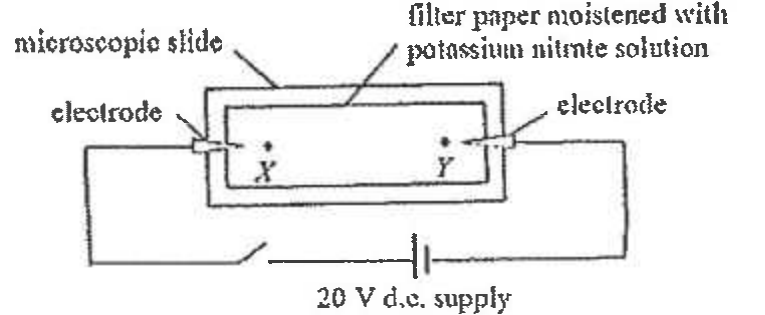
After the circuit has been closed for some time, a coloured patch is formed between X and Y. What is the colour of the patch ?
Directions: Q.6 and Q.7 refer to the following experiment: A drop of silver nitrate solution and a drop of sodium iodine solution are placed respectively at X and Y as shown in the diagram below:
The main aim of this experiment is to show that
Which of the following contains the same number of atoms as 2.20 g of carbon dioxide ? (Relative atomic masses: H = 1.0, C = 12.0, N = 14.0, O = 16.0, S = 32.0, Cl = 35.5)
On strong heating, a solid X decomposes to give a solid residue and a brown gas. The solid residue can react with concentrated nitric acid with evolution of a brown gas. X is probably
In which of the following experiments will a redox reaction occur ?
When a substance X is electrolyzed using platinum electrodes, a gas is collected at each electrode. X may be