溫度、熱和內能
物理 · 共 29 題 · 點擊選項即時核對答案
Two liquids and are heated by two different heaters. The energy supplied, the mass of the liquid and the temperature rises are recorded as follows.
| Liquid | Liquid | |
|---|---|---|
| Energy supplied / J | 24000 | 18000 |
| Mass / kg | 0.3 | 0.2 |
| Temperature rise / C | 20 | 25 |
Which of the following statements are correct ?
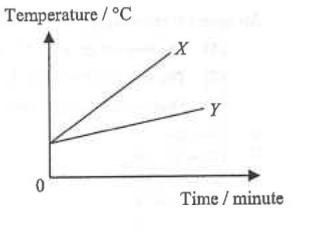
The figure shows the temperature-time graph of two objects and when they are heated at the same power. Which of the following deductions are correct ?
Which of the following descriptions about internal energy are correct ?
A bottle of kg water and a bottle of kg water have been stored in a refrigerator for a few days. Which of the following statements are correct ?
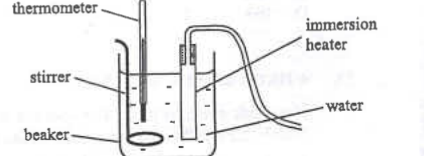
A W immersion heater is used to heat kg of water, which is being stirred by a stirrer. After minutes, the water temperature increases from to . What is the estimated energy loss in this period ? Given : specific heat capacity of water
What physical properties does the temperature of an object represent ?
Four liquids , , and with the same mass are heated at the same rate. The graph below shows the variation of their temperatures with time.
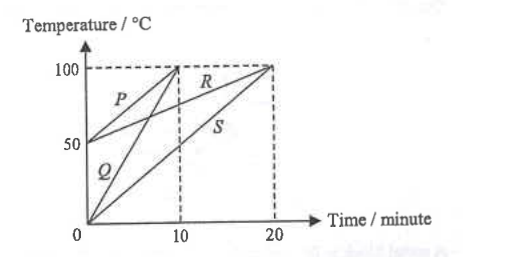
Which liquid has the highest specific heat capacity ?
If there is no heat flow between two bodies when in contact, then the two bodies must have the same
A student uses an electric kettle to heat kg of water at . The water boils in minutes. Estimate the output power of the kettle. The specific heat capacity of water is .
Questions 20 and 21 : The specific heat capacity of a metal is measured using the following method :
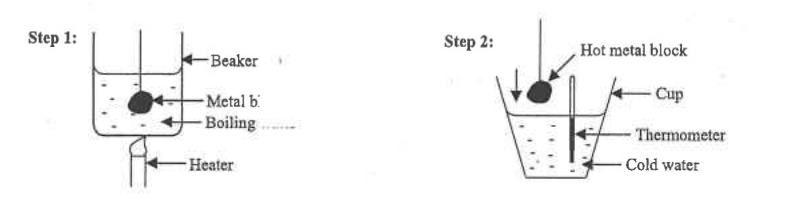
A metal block is first immersed in boiling water for some time. The block is then transferred to a cup of cold water. After a while, the temperature of the water is measured.
The result of the experiment is as follows : Mass of metal block kg Mass of water in the cup kg Initial temperature of water in the cup Final temperature of water in the cup Find the specific heat capacity of the metal (in ). (Given : Specific heat capacity of water .)