2000 年
物理 · 共 28 題 · 點擊選項即時核對答案
It is said that Galileo Galilei (1564 - 1642), an Italian scientist, dropped a small iron ball and a large cannon ball from the top of the Leaning Tower of Pisa. He found that the two balls reached the ground at almost the same time. Which of the following is/are correct deduction(s) from this experiment ?
A racing car accelerates from rest to a speed of km h in s. Find the average acceleration of the car.
An astronaut lands on the moon and finds that his weight is about one-sixth of that on the earth. Which of the following deductions is/are correct ?
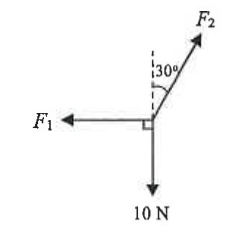
Three forces of magnitudes , and N act on an object as shown. If the object is in equilibrium, find the force .
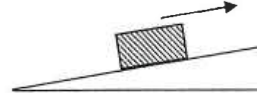
A block is placed on a rough inclined plane and then projected upwards along the plane. After reaching the highest point, the block slides down along the plane. Which of the following graphs shows the time variation of the velocity of the block ?

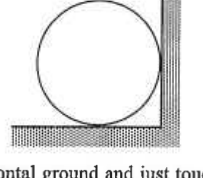
A uniform steel ball lies at rest on a horizontal ground and just touches a vertical wall as shown in the diagram. Which of the following diagrams shows all the forces acting on the ball ? (Note : = gravitational force acting on the ball, = normal reaction from the ground, = friction acting by the ground on the ball, = normal reaction from the wall.)

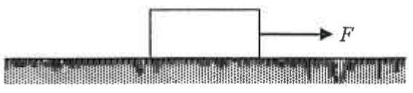
A block is placed on a rough horizontal ground and a horizontal force acts on the block. If the magnitude of the force, , is increased gradually, which of the following graphs shows the relation between and the acceleration of the block ?

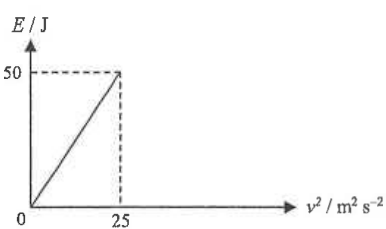
The graph shows the variation of the kinetic energy of an object with the square of its velocity moving on a straight line. What is the momentum of the object when it is moving at a velocity ?
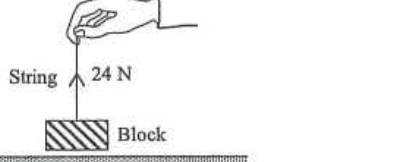
A kg block is initially at rest on the ground. A man uses a force to pull up the block as shown above. If the tension in the string is kept at N and the block reaches a height of m in s, which of the following statements is/are correct ?
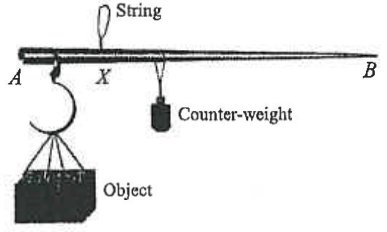
A company intends to produce a kind of weighing device as shown. The device is held at point . The position of the counter-weight is adjusted until the rod becomes horizontal. The weight of the object can be read from the scale calibrated on . Which of the following changes can increase the maximum weight that can be measured by the device ?